
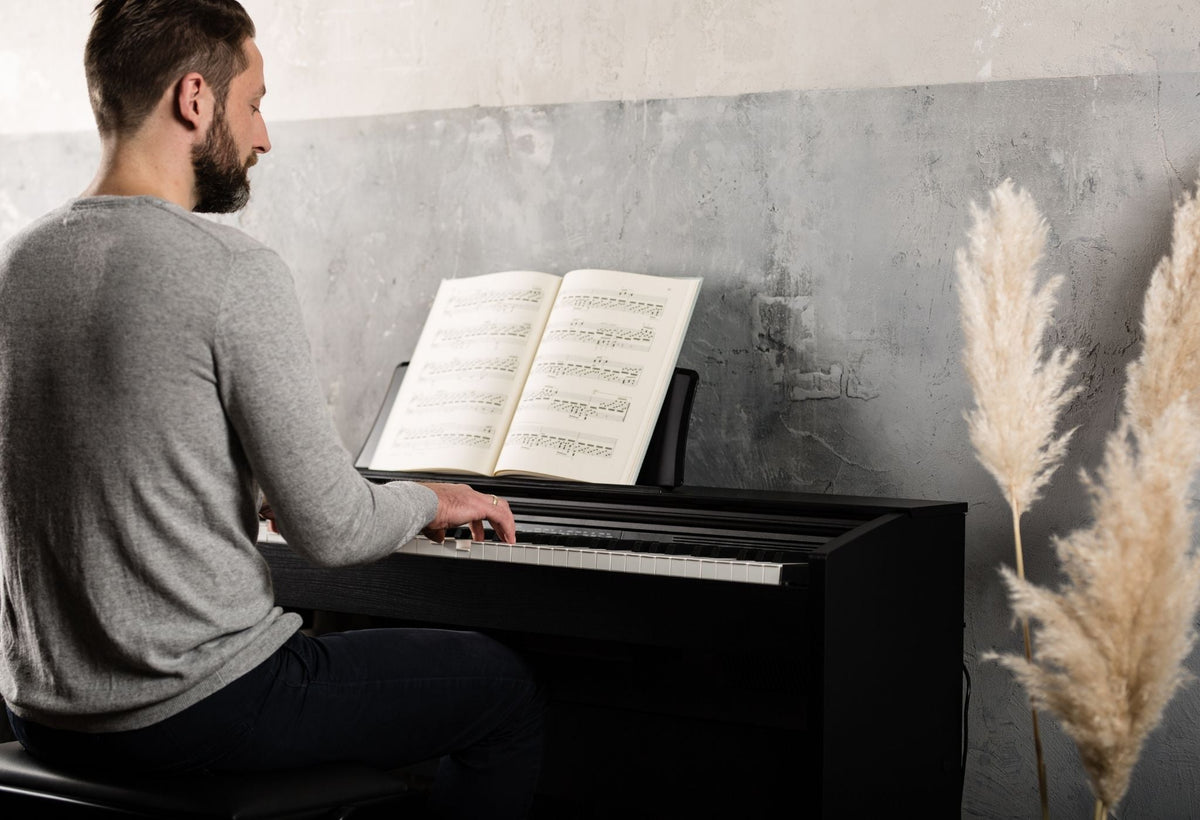
Three pedals at your feet. The one on the right gets all the attention, the one on the left occasionally gets a look-in, and the middle one sits there wondering why it bothered turning up.
But that middle pedal has a few tricks up its sleeve. Depending on your digital piano, it can do everything from holding selected notes to turning the pages of your music. Quite impressive for something you might have been using as a footrest.
Its main job: sostenuto
The middle pedal usually acts as the sostenuto pedal. Italian name, slightly mysterious reputation, surprisingly straightforward job.
It holds on to only the notes you’re playing when you press it. Anything you play afterwards behaves normally.
Give this a go:
1. Play a low note or chord and keep your fingers on the keys.
2. Press and hold the middle pedal.
3. Lift your fingers.
4. Play a few notes higher up the keyboard.
The original notes keep ringing while the new ones stay separate. Release the pedal and the held notes fade away. It’s rather like asking someone to hold your place while you nip off and do something else.
This is useful when you want a bass note to continue underneath a melody without everything merging into musical soup. The right-hand sustain pedal also holds new notes played while it’s down; sostenuto is more selective.
A little organ-playing drama
Select an organ sound on certain digital pianos and the middle pedal may take on another job: switching the rotary-speaker effect between slow and fast.
That’s the swirling sound associated with classic organ playing. Changing its speed can give a passage a gentle shimmer or a more lively wobble—all while your hands carry on playing.
Some models also offer assignable pedal functions such as pitch bend or vibraphone rotor control. The exact options depend on the piano, so three pedals don’t automatically mean you’ve bought a small effects department.
Press play—with your foot
On suitably equipped digital pianos, the middle pedal can be assigned to start or pause song playback.
If you’re practising alongside a recording, this saves you reaching for a button just as you’ve finally got both hands in the right place.
Whether your piano supports it is a question for the manual. Yes, that booklet you put somewhere safe and haven’t seen since.
Turning pages without the scramble
With a compatible piano and app, the middle pedal can even turn digital sheet-music pages.
Supported Casio setups, for example, let you use the centre pedal to advance the score in CASIO MUSIC SPACE. Rather handy when the alternative is taking one hand off the keyboard, poking the screen and hoping the music waits for you.
You’ll need a supported instrument and the correct setup, but it’s a useful little feature.
Doesn’t it make the piano quieter?
You might remember a middle pedal on an acoustic upright that made everything sound rather muffled.
On many uprights, that’s a practice pedal, which places felt between the hammers and strings. It has a different job from sostenuto.
Digital pianos generally make quiet practice much simpler: turn the volume down or plug in headphones. Peace for the household, and nobody has to hear that tricky bar for the forty-seventh time.
Give the forgotten pedal a chance
You don’t need to master all three pedals to enjoy playing. But the middle one deserves a little attention—it might be more useful than you think.
Pop into Wessex Pianos in Salisbury and we’ll happily show you what the pedals do on our Yamaha and Casio digital pianos. Bring your curiosity. We’ll provide the piano.

Leave a comment
This site is protected by hCaptcha and the hCaptcha Privacy Policy and Terms of Service apply.